Teflon Dangers: When to Replace Your Old Pans (2026 Guide)
A science-backed guide to Teflon dangers in 2026 — covering PTFE thermal degradation, microplastic shedding, the IARC carcinogenicity update, Canada’s new PFAS regulations, and when to replace your non-stick pans.
This guide reflects publicly available scientific research, IARC monographs, and Canadian federal regulations as of March 2026. We have not independently lab-tested cookware products. Affiliate links support Boreal Living at no extra cost to you.
Editor's pick
All-Clad D3 Stainless Steel Tri-Ply 10-Inch Fry Pan
Affiliate link — we may earn a commission at no extra cost to you.
At a Glance
Key Risk
~9,100 particles per surface crack
Safe Temp Limit
Below 260°C (500°F)
IARC Classification
PFOA is Group 1 carcinogen (2023)
PTFE Lifespan
1–5 years typical
Heirloom Pick
Lodge Cast Iron ($45)Pro Pick
All-Clad D3 Stainless ($220)Modern Pick
GreenPan Valencia Pro ($90)Canada Regulation
PFAS ban in force June 30, 2026
What Makes Teflon Dangerous? The Molecular Reality of PTFE
For decades, non-stick cookware was the symbol of modern kitchen efficiency in Canadian homes — but the Teflon dangers that scientists have documented since 2022 are changing that calculus. A series of landmark studies and sweeping federal regulatory changes have fundamentally altered the risk profile of polytetrafluoroethylene (PTFE), the chemical coating commonly known by the brand name Teflon.
What Is PTFE?
Polytetrafluoroethylene is a high-molecular-weight polymer consisting entirely of carbon and fluorine. The carbon-fluorine bond is one of the strongest in organic chemistry, providing the material with its signature properties: extreme hydrophobicity, a very low coefficient of friction, and high thermal resistance. These attributes made PTFE the premier choice for non-stick surfaces starting in the mid-20th century.
However, the very stability that makes PTFE effective for cooking also makes it an environmental and biological hazard. PTFE belongs to the broader class of per- and polyfluoroalkyl substances (PFAS), a group of thousands of human-made chemicals (commonly estimated at over 10,000) often referred to as “forever chemicals” because they do not break down in the environment or the human body. Historically, the production of Teflon involved a surfactant called perfluorooctanoic acid (PFOA). While PFOA was largely phased out by major manufacturers between 2013 and 2015 due to its link to kidney and testicular cancer, it remains a significant concern for those using non-stick pans manufactured before that period.
Pre-2015 pans: a hidden risk in your kitchen
If any of your non-stick cookware was purchased before 2015, it may contain PFOA — a chemical now classified as a Group 1 carcinogen by the International Agency for Research on Cancer (IARC). Even if the coating appears intact, consider replacing these pans as a precautionary measure.
The modern “Teflon dangers” profile has shifted from PFOA exposure to risks inherent in the PTFE polymer itself. Even when PFOA-free, PTFE-coated pans remain susceptible to thermal degradation and mechanical wear, leading to the release of toxic fumes and microplastic particles. (The same concerns apply to other kitchen appliances with non-stick coatings — see our non-toxic air fryer guide for related advice.)
The Real Dangers: Thermal Degradation and Microplastic Shedding
Non-stick cookware is safe only while its coating remains intact and below critical temperatures. Once either condition fails, contamination happens quickly — and invisibly.
The Thermal Threshold: Teflon Fumes and Toxicity
The Teflon safe temperature is generally cited as being below 260°C (500°F). Beyond this point, the PTFE coating undergoes thermal degradation, releasing a complex mixture of gases and ultrafine particulates. Research indicates that an empty non-stick pan can reach these temperatures in as little as two to five minutes on a standard residential burner.
| Temperature | What Happens | Health Impact |
|---|---|---|
| Below 260°C (500°F) | Stable polymer state | Generally considered safe for routine use |
| 260°C–300°C | Initial pyrolysis begins | Release of irritating fumes and ultrafine particles |
| 300°C–450°C | Advanced thermal breakdown | Onset of Polymer Fume Fever (“Teflon flu”) |
| Above 450°C (842°F) | Highly toxic gas release | Production of PFIB and carbonyl fluoride |
Below 260°C (500°F)
Stable polymer state
Generally considered safe for routine use
260°C–300°C
Initial pyrolysis begins
Release of irritating fumes and ultrafine particles
300°C–450°C
Advanced thermal breakdown
Onset of Polymer Fume Fever (“Teflon flu”)
Above 450°C (842°F)
Highly toxic gas release
Production of PFIB and carbonyl fluoride
The condition known as “Teflon flu” or polymer fume fever is characterized by symptoms that mimic a severe viral infection. Typical symptoms include shaking chills, high fever, muscle aches, headache, and chest tightness. While these symptoms generally resolve within 24 to 48 hours for humans, the fumes are lethal to pet birds, whose highly efficient respiratory systems are unable to filter the toxic particulates. Some toxicological research suggests that repeated occupational-level exposure to PTFE fumes may contribute to lasting respiratory effects, though household exposure at typical cooking levels is less studied.
Bird owners: critical safety warning
Birds have a unique respiratory system with air sacs that allow them to process high levels of oxygen. This makes them extremely sensitive to airborne toxins. PTFE fumes can cause immediate hemorrhaging in a bird’s lungs, leading to sudden death — even from a pan heated in an adjacent room. If you keep birds, remove all PTFE-coated cookware from your home.
The Microplastic Crisis: The Flinders University Study
A groundbreaking 2022 study conducted by Flinders University and the University of Newcastle utilized Raman imaging to quantify the release of plastic debris from non-stick pans. The findings provided a staggering look at the scale of ingestion risk. The research demonstrated that a single scratch on a Teflon-coated pan could release approximately 9,100 plastic particles during a single cooking session.
When the coating is further compromised or reaches the end of its functional life, the release of microplastics (particles smaller than 5 mm) and nanoplastics (particles smaller than 1 μm) scales exponentially. At a micro-scale, the study identified the release of up to 2.3 million micro- and nanoplastics from broken or severely degraded coatings. These particles, once ingested, can persist in human tissues. Preliminary research has explored potential associations between microplastic exposure and inflammatory responses, though this area of study is still in its early stages.
Carcinogenicity and the IARC 2023 Update
The PFOA cancer risk has been a subject of regulatory debate for decades. In November 2023, the International Agency for Research on Cancer (IARC) re-evaluated the carcinogenicity of PFOA and perfluorooctanesulfonic acid (PFOS). The working group classified PFOA as Group 1 (“carcinogenic to humans”) — a significant upgrade from its previous classification. This was based on “sufficient” evidence in experimental animals and “strong” mechanistic evidence in exposed humans.
Epidemiological data has consistently shown higher kidney cancer incidence and mortality among individuals with high PFOA exposure. Additional research suggests differential risks for breast cancer subtypes and associations with testicular cancer. In 2024, the U.S. EPA finalized enforceable drinking water limits for PFOA and PFOS at just 4 parts per trillion — reflecting growing scientific consensus on the health risks of these compounds. For Canadian households, this underscores the danger of continuing to use old non-stick pans that may still harbour these legacy chemicals.
PFAS-Free Alternatives: Our Top Picks
Affiliate links — we may earn a commission at no extra cost to you.
Signs to Replace: The Non-Stick Pan Replacement Guide
Identifying when to replace your non-stick pans is the most critical step in maintaining a non-toxic home. Manufacturers often suggest a five-year lifespan, but recent data suggests that the safety window may be significantly shorter depending on usage patterns.
Use the interactive checklist below to evaluate the condition of your current non-stick cookware.
Pan Replacement Checklist
Check each condition that applies to your non-stick pan. Tap any item for details.
Assessment (0 of 7 checked)
Check any conditions that apply to your pan to get a personalized recommendation.
1. Visible Surface Damage
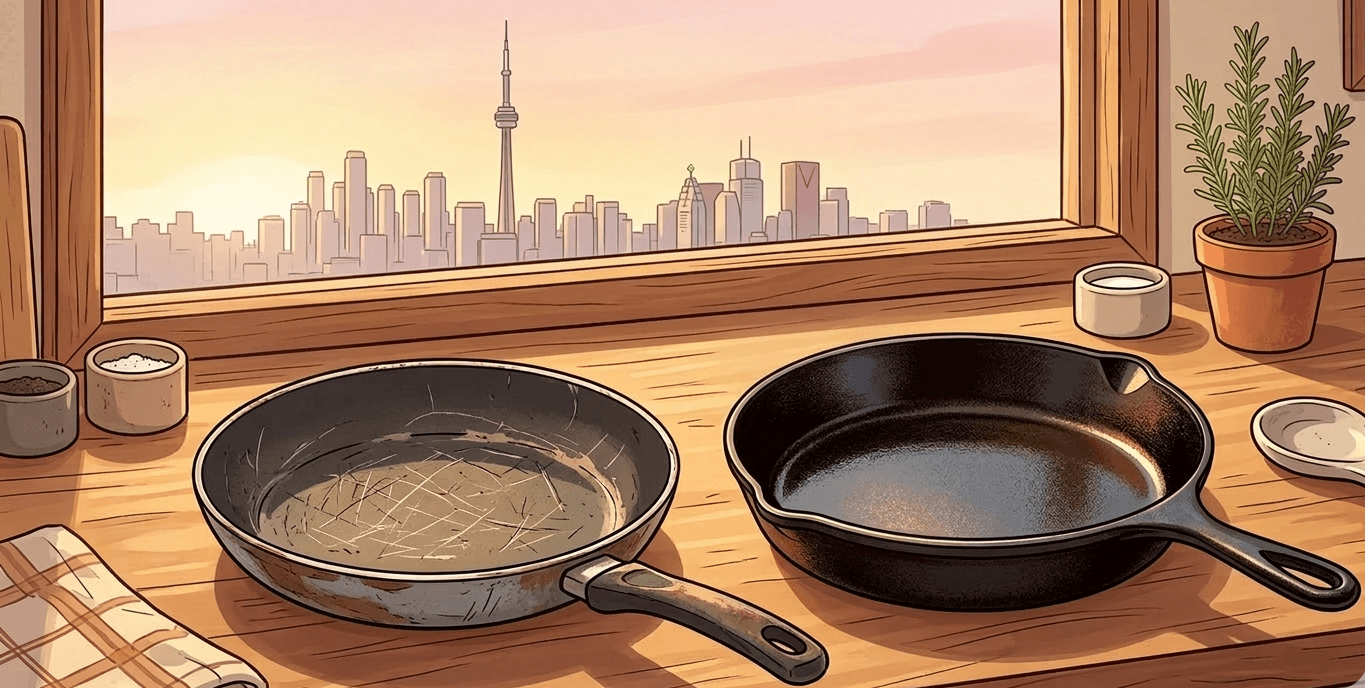
The primary indicator that a pan is no longer safe is physical trauma to the coating. If Teflon coating peeling is visible, the pan must be removed from service immediately. Similarly, a scratched pan evaluation is straightforward: if you can see a scratch, the pan is shedding microplastics into your food. Even “micro-scratches” caused by metal utensils or abrasive cleaning can compromise the chemical stability of the PTFE layer.
2. Loss of Non-Stick Performance
When the effortless release of food begins to fail, it is a sign that the polymer has reached its functional limit. This typically happens because the surface has become pitted or the non-stick molecules have carbonized due to repeated exposure to high heat. Continuing to use a pan where food consistently sticks forces the user to apply more mechanical force or abrasive cleaning, which further accelerates the release of PTFE debris.
3. Discoloration and Staining
A significant change in the colour of the pan — shifting from the original grey or black to a brownish or mottled appearance — indicates that the coating has been thermally compromised. This discoloration is often a result of grease building up in the microscopic cracks of a degraded polymer, making the surface nearly impossible to sanitize and chemically unstable.
4. Warping of the Base
A pan that no longer sits flat on the stove is a safety hazard for two reasons. First, it causes uneven heat distribution, creating hot spots that can easily exceed the safe temperature limit for PTFE. Second, the mechanical stress required to warp a metal pan often causes the non-stick coating to delaminate or crack at a molecular level.
The Lifespan Truth: Non-Stick as “Fast Fashion” for the Kitchen
The durability of cookware is inversely proportional to its non-stick convenience. While cast iron and stainless steel are considered “heirloom” items that can last for generations, non-stick pans are essentially disposable goods.
| Material | Lifespan | Construction | Sustainability |
|---|---|---|---|
| Traditional PTFE (Teflon) | 1–5 Years | Aluminum + synthetic coating | Low — non-biodegradable coating |
| Ceramic Coating | 1–3 Years | Metal + silica-based coating | Moderate — PFAS-free but short life |
| Stainless Steel | 20+ Years | Bonded steel/aluminum layers | High — 100% recyclable, no coatings |
| Cast Iron | Lifetime | Molten iron | High — indestructible, naturally non-stick |
Traditional PTFE (Teflon)
1–5 YearsAluminum + synthetic coating
Low — non-biodegradable coating
Ceramic Coating
1–3 YearsMetal + silica-based coating
Moderate — PFAS-free but short life
Stainless Steel
20+ YearsBonded steel/aluminum layers
High — 100% recyclable, no coatings
Cast Iron
LifetimeMolten iron
High — indestructible, naturally non-stick
The economic reality is telling: a cheap non-stick pan may cost CAD $30, but replacing it every two years adds up to $150 or more over a decade — approaching the price of a quality stainless steel pan that lasts 20+ years. From an environmental perspective, the “fast cookware” cycle contributes a growing stream of non-recyclable, PTFE-coated metal to landfills each year.
The 2026 Canadian Regulatory Context
The regulatory environment in Canada has evolved rapidly to address the “forever chemical” crisis. On December 31, 2025, the Government of Canada published the Prohibition of Certain Toxic Substances Regulations, 2025 (SOR/2025-270). These regulations come into full force on June 30, 2026, replacing the 2012 framework.
Key impacts of the 2026 regulations include:
- Expansion of prohibited substances: The new regulations significantly tighten restrictions on PFOA, PFOS, and LC-PFCAs.
- Removal of exemptions: Previous exemptions that allowed for trace amounts of these chemicals in consumer products are being removed or severely limited.
- Supply chain accountability: Manufacturers and importers must now provide detailed documentation proving that their products are free from prohibited PFAS.
While the regulations do not currently ban all PTFE, they effectively ban the sale and import of any non-stick products that contain the most hazardous legacy chemicals often found in older or lower-quality imported cookware. Health Canada and Environment and Climate Change Canada (ECCC) have signalled that they are evaluating the entire class of PFAS for future restriction, moving toward a comprehensive phase-out of non-essential uses.
What the regulation means for your kitchen
If you own non-stick cookware purchased from a reputable Canadian retailer after 2016, it is likely PFOA-free. However, the new regulations target a broader range of PFAS. The safest long-term strategy is to transition to materials that contain zero fluoropolymer coatings — cast iron, stainless steel, or certified ceramic.
Top 3 PFAS-Free Alternatives for Canadian Kitchens
These three materials eliminate PTFE entirely while matching or exceeding non-stick performance for most cooking tasks. All are available from Canadian retailers and pair well with our full PFAS-free cookware guide.
1. The Heirloom Choice: Lodge Seasoned Cast Iron
Cast iron is the original non-toxic cookware. The Lodge 10.25-Inch Pre-Seasoned Cast Iron Skillet is naturally non-stick when seasoned with vegetable oil and is incredibly versatile, moving seamlessly from stovetop to oven to campfire. Priced at approximately CAD $45 on Amazon.ca, it lasts a lifetime and actually improves with age. Cast iron can also contribute a small amount of dietary iron during cooking — beneficial for most people.
2. The Professional Choice: All-Clad D3 Stainless Steel
For those who value precision and durability, the All-Clad D3 Stainless Steel 10-Inch Fry Pan is the industry standard. Its tri-ply construction (stainless/aluminium/stainless) delivers rapid heat response without any chemical coatings. Priced at approximately CAD $220 on Amazon.ca, it is oven and broiler safe to 600°F, induction compatible, and non-reactive — meaning you can cook acidic tomato sauces without metallic taste. Made in the USA with a limited lifetime warranty.
3. The Modern Choice: GreenPan Valencia Pro Ceramic
If the convenience of a synthetic non-stick surface is still desired, ceramic coatings are the safest modern option. The GreenPan Valencia Pro 10-Inch Frying Pan uses Thermolon™ ceramic non-stick derived from sand (silica), completely free of PTFE, PFOA, and other PFAS chemicals. Available on Amazon.ca for approximately CAD $90, it offers the easiest “eggs and crêpes” release without the risk of polymer fume fever if accidentally overheated. The Magneto™ induction base provides excellent stability on modern cooktops.
For a deeper dive into PFAS-free alternatives
Our comprehensive companion guide, Best PFAS-Free Cookware in Canada (2026), reviews 10 products with a full comparison table, material safety rankings, and Canadian buying tips. If you’re ready to build a complete non-toxic kitchen, start there.
Disposal in Canada: How to Recycle Old Non-Stick Pans
Disposing of old Teflon pans is a unique challenge in the Canadian waste stream. Because the PTFE coating is a persistent pollutant, these items should not be placed in standard curbside recycling bins unless specifically instructed by your municipality.
Provincial Breakdown for 2026
- Ontario: Most municipalities, including Peel, Durham, and Niagara, classify cookware as “scrap metal” or “bulky waste.” Take old pans to a Community Recycling Centre (CRC) or schedule a metal goods pickup. Scrap metal yards (e.g., Attar Metals) will often accept these items for material recovery.
- British Columbia: Recycle BC excludes pots and pans from curbside collection. They are typically accepted at specialized depots as “scrap metal.”
- Quebec: Metal cookware is diverted from the “bac de récupération” and should be taken to an “écocentre” for proper processing.
Private Solution: TerraCycle Canada
For consumers who want to ensure 100% of the material — including the non-stick coating — is managed responsibly, TerraCycle offers a “Kitchen Gear Zero Waste Box.” Boxes cost several hundred dollars CAD depending on size, making them more suitable for community groups or large households. The box is ordered, filled with old cookware, and shipped back to TerraCycle using a pre-paid UPS label.
Frequently Asked Questions
Filter by category or tap any question to reveal the answer. These answers reflect the 2023 IARC monographs, the Flinders University microplastics study, and current Canadian regulations.
Get Smarter About Your Home
Weekly tips on gardening, home projects, and living well.
The Boreal Living Verdict
The science is now clear: damaged Teflon pans are a daily source of microplastic and chemical exposure. The 2022 Flinders University study demonstrated that a single surface crack releases thousands of particles per session, while the IARC’s 2023 Group 1 classification of PFOA confirmed what epidemiologists had long suspected. Canada’s 2026 PFAS regulations, coming into force June 30, are the regulatory response to these findings.
If your pan shows any critical sign from the checklist above — visible scratches, peeling, or a pre-2015 manufacture date — replace it today. If it shows warning signs like sticking or discoloration, plan a replacement within weeks. For new purchases, cast iron and stainless steel offer the best long-term value and zero chemical risk. If non-stick convenience is essential, a PFAS-free ceramic pan like the GreenPan Valencia Pro is the safest modern option.