The Ultimate Guide to Homemade Dog Treats: Motivation Science and Food Safety (2026)
Master the science of safe, cost-effective homemade dog treats — from training reward psychology and bacterial heat-shock protocols to toxic ingredient awareness and kitchen-tested techniques.
This guide is for informational purposes only. Always consult your veterinarian before introducing new foods to your dog’s diet, especially for dogs with existing health conditions.

At a Glance
Cost Savings
60–90% vs. commercial treats
Beef Safe Temp
71°C (160°F) internal
Poultry Safe Temp
74°C (165°F) internal
Post-Dry Heat Shock
126°C (257°F) for 10 min
Dehydrator ROI
Pays for itself in ~4 months
Top Danger
Xylitol: liver failure in minutes
The Reward Dilemma
For every dog owner committed to training, the moment of reward is sacred. It’s the instant the bond deepens. Yet a persistent dilemma remains: how do you motivate your companion without compromising their metabolic health — or your budget?
Flip over any bag of commercial treats and the picture gets murky fast. Synthetic preservatives, hidden sugars, ambiguous colorants, and ingredient lists that read like a chemistry final. The skepticism is warranted.
Going homemade isn’t just a budget hack — it’s an act of informed care. In the kitchen, you can marry the rigour of food safety science with the psychology of positive reinforcement, turning every training session into a resounding success.
Understanding the Treat Value Hierarchy
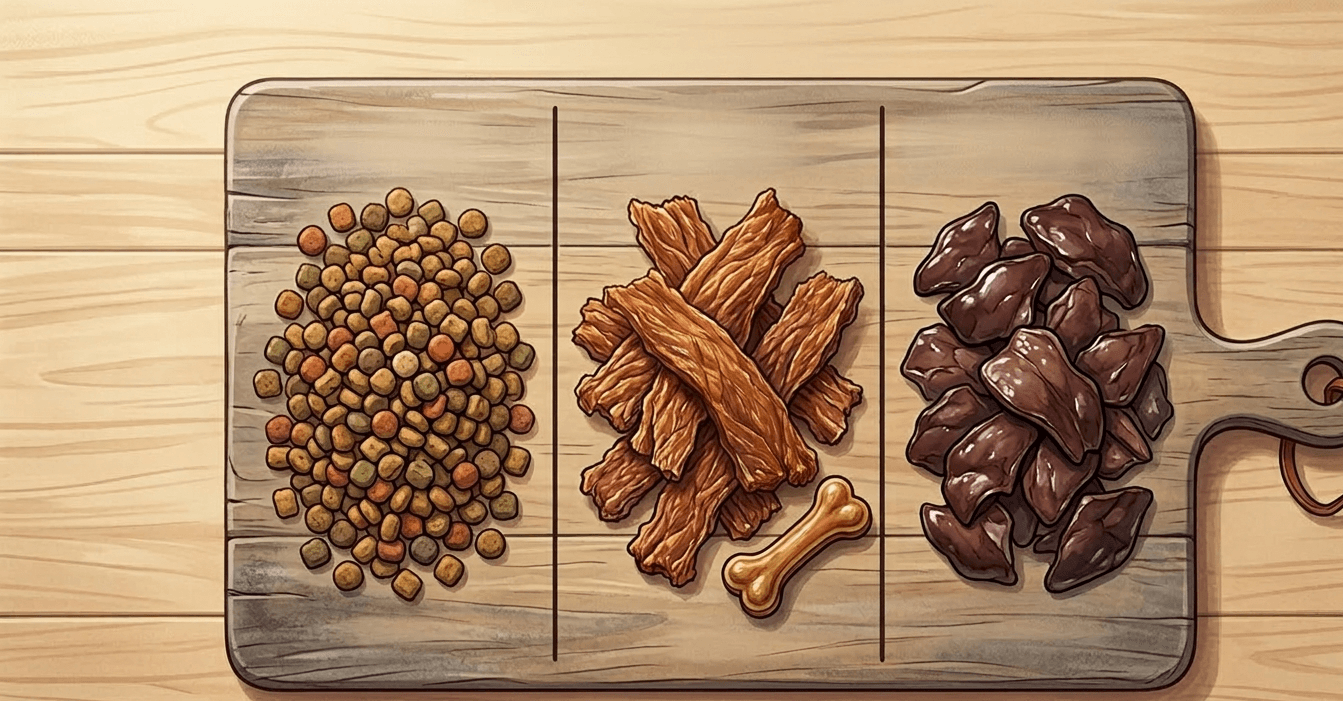
In canine behavioural psychology, treats are more than food — they’re a behavioural currency. For a reliable response, the “pay” must match the difficulty of the task. High-value treats trigger an intense dopaminergic response, essential for emergency recall or stress management in overwhelming environments.
Treat Value Hierarchy
| Value Level | Characteristics | Best Used For | Logistics |
|---|---|---|---|
| Low | Dry, mild odour (e.g. kibble pieces, carrot coins) | Calm indoor setting, reinforcing well-known commands | Clean, stays fresh in a pocket for hours |
| Medium | Semi-moist, noticeable scent (e.g. homemade jerky, green beans) | Fenced yard, learning new tricks or sequences | Needs a treat pouch; use within the session |
| High (Jackpot) | Moist, intense aroma, pure protein (e.g. liver, chicken) | Distracting environments (park, vet clinic, emergency recall) | Must be non-greasy for quick delivery; keep refrigerated |
The Two-Second Rule and the “Jackpot”
A reward must be consumed in under two seconds. If your dog spends ten seconds chewing, the cognitive link between the action and the reward weakens. Worse, a treat that crumbles redirects attention — the dog ends up “hunting” crumbs on the floor instead of refocusing on you.
The Jackpot concept — a shower of small, high-value treats — is reserved for major breakthroughs: the first solid recall in a busy park, or a calm stay at the vet’s office. It reinforces the idea that exceptional effort earns exceptional pay.
The Non-Negotiable Safety Step: Heat Shock
Home dehydration carries a bacterial risk that’s often underestimated: the survival of Salmonella and E. coli. At low temperatures (60–70°C), bacteria can develop thermal resistance through environmental stress adaptation. To guarantee safety, food scientists validate two methods:
Pre-Heating Method
Steam or poach the meat until it reaches an internal temperature of 71°C (160°F) for beef or 74°C (165°F) for poultry before placing it in the dehydrator. Moist heat is a far more efficient conductor for destroying pathogens than dry air alone.
Post-Drying Heat Shock
Recommended by Oregon State University’s Extension Service for preserving the traditional jerky texture:
Oregon State University Extension Protocol
“Jerky is considered safe only when it has been sufficiently heated to destroy pathogens. Place dried meat strips on a baking sheet in an oven preheated to 126°C (257°F) for 10 minutes to effectively eliminate residual bacteria.”
This step is critical for lowering water activity (aw) to a level where microbial proliferation becomes biologically impossible. Combined with proper drying, it creates a shelf-stable product that’s genuinely safe.
Don’t Skip This Step
Low-temperature dehydration alone does not guarantee pathogen elimination. Even if the jerky looks and feels dry, internal moisture pockets can harbour bacteria. Always apply one of the two validated methods above.
The Financial Case for Homemade
Investing in a dehydrator is one of the most cost-effective moves a dog owner can make. Premium brands charge a steep markup for “purity” — but based on real preparation data, the numbers speak for themselves.
Treat Cost Calculator
Homemade per oz
$0.81
Commercial per oz
$1.20
Annual savings
$81
33% less than commercial
Dehydrator payback
52 wk
~13 months
The baseline math: buying 1 kg of lean beef at $10 produces treats at roughly $0.25 per ounce. Commercial premium treats (freeze-dried liver, single-ingredient jerky) range from $0.60 to $2.17 per ounce. That’s a 60–90% reduction in treat costs. A mid-range dehydrator pays for itself in under four months of active training.
Already have an air fryer with a dehydration mode? You may not need a dedicated unit at all. Our non-toxic air fryer guide covers which models reach the low temperatures needed for safe jerky making — some go as low as 80°F.
Health Customization: A Vital Support Tool
For dogs battling serious conditions like cancer, controlling ingredients isn’t a preference — it’s a matter of survival. Cancer cells feed preferentially on glucose (sugars and carbohydrates). Homemade treats let you eliminate the starchy fillers found in most commercial options in favour of a diet rich in omega-3s and pure protein.
The Yasha Story
Yasha, a seven-year-old dog diagnosed with a cancerous tumour, was given six months to live. Her owner, Megan Gilmore, overhauled her treat regimen — banning all grains and sugars — as part of a broader dietary shift. Yasha lived to 13. While no single factor explains that outcome, the total control over glycemic load that homemade treats provide made it possible to turn every reward into a tool of metabolic support rather than a metabolic liability.
This level of ingredient control is simply unavailable with off-the-shelf products. Whether your dog needs a low-fat diet for pancreatitis, a novel protein for allergies, or a zero-carb approach for cancer support, the kitchen gives you that power.
Chef Tips for Mess-Free Treats
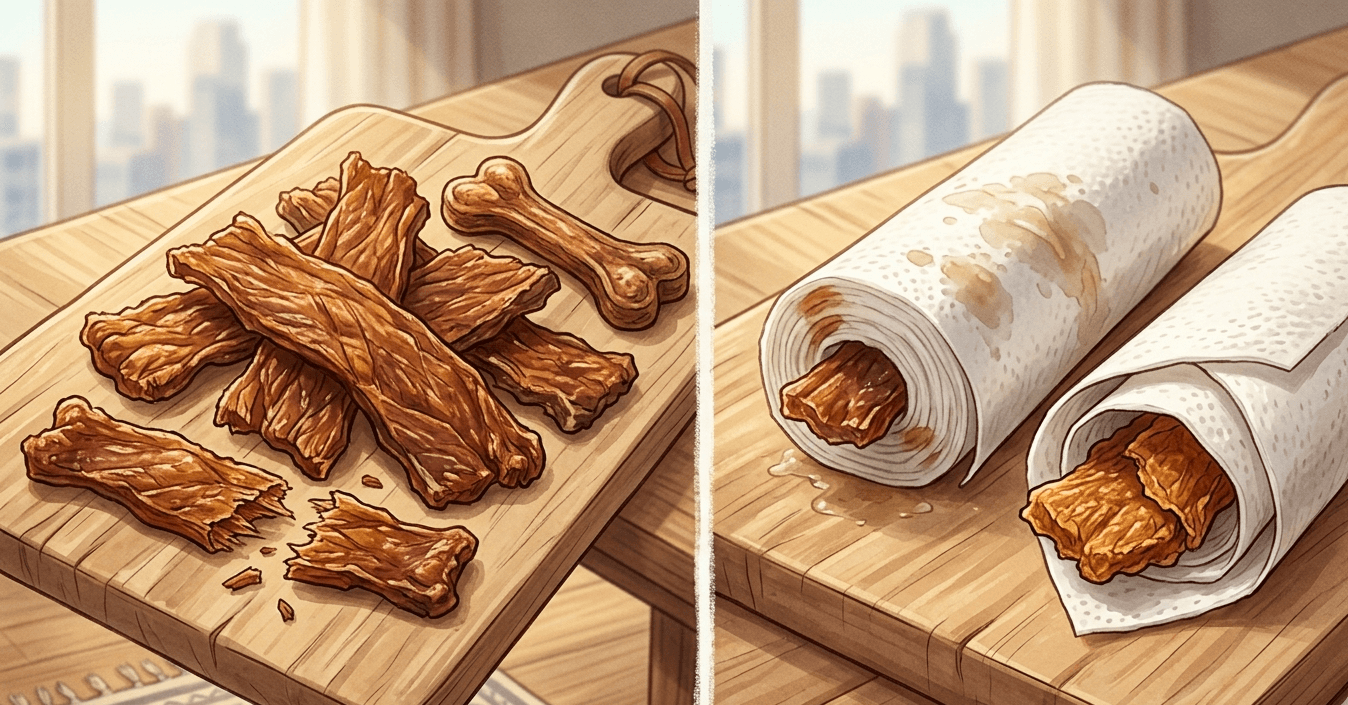
Practicality is the key to consistency in training. If your treats are greasy, crumbly, or inconvenient, you’ll stop making them. Here’s how to optimize your prep:
The Microwave Method
For hot dogs (the ultimate high-value reward, but notoriously greasy): dice them to pea-sized pieces and microwave for 8–10 minutes on layers of paper towel. This expels both water and fat, leaving behind dry, pocket-friendly pellets that won’t stain your treat pouch.
The Paper Towel “Burrito”
After pan-searing meat, roll the diced pieces tightly in several layers of paper towel, pressing firmly. This wicks away excess lipids. Why does this matter? Fats don’t dehydrate — they undergo lipid oxidation, causing rancidity. Removing surface fat before drying extends shelf life dramatically.
Smart Poaching
Use the poaching liquid (without salt or onions) to create enrichment ice cubes — freeze the broth in ice cube trays for a separate, zero-calorie reward on hot days.
Beware of Case Hardening
Never start dehydrating at too high a temperature. This creates a dry crust on the surface that traps moisture inside, providing the perfect environment for internal mould growth. Start low (around 60–65°C / 145°F) and let the moisture migrate outward gradually, then apply the heat-shock protocol at the end.
Toxic Ingredients: The Science
Your kitchen contains compounds that are lethal to dogs. Never add these to homemade treats, even in trace amounts.
Toxic Ingredient Reference
Common Sources
Sugar-free peanut butter, gum, mints, baked goods
Mechanism of Toxicity
Triggers massive insulin release causing rapid hypoglycemia, followed by acute hepatic necrosis (liver failure).
Onset
15–30 minutes
Symptoms
Vomiting, collapse, seizures, liver failure
A note on liver: it’s one of the best high-value training treats available, but portion control is essential. Liver is extraordinarily rich in preformed retinol (vitamin A). Chronic overfeeding leads to hypervitaminosis A, which manifests as skeletal deformities, joint stiffness, and bone spurs. Limit liver to 5–10% of total treat intake and rotate with other proteins like chicken breast, beef heart, or lean turkey.
Toward a Stronger Bond Through the Bowl
Mastering homemade treat production is about reclaiming control over your dog’s health and training trajectory. By following the heat-shock safety protocol and calibrating reward value to the difficulty of the task, you optimize every single interaction.
The investment is time — a few hours per month of batch preparation. The return is years of deepened partnership and preserved health. Every batch you pull from the dehydrator is a statement: that the well-being of your companion isn’t negotiable, and that the science backs you up.
One question to close on: in your own treat hierarchy, what would be the ultimate “Jackpot” — the one reward for which your dog would do absolutely anything?