Balcony Garden Guide for Canadian High-Rises (2026)
Five practical strategies to turn your condo balcony into a productive edible garden — microclimate assessment, grow bag comparisons, dwarf vegetable picks, and wind-proofing for Canadian high-rises.
This guide draws on general horticultural principles, manufacturer specifications, and the practical experience of Canadian balcony gardeners. Prices are approximate and may vary.
Editor's pick
Smart Pots 7-Gal Original
Affiliate link — we may earn a commission at no extra cost to you.
At a Glance
Zone Shift
~½ to 1 zone colder per 10–15 floors
Best Starter Variety
Tiny Tim Tomato (45–55 days)
Planting Delay
+10–14 days vs ground level
Top Container
Fabric grow bags (air pruning)
Best Substrate
Pro-Mix Mycoactive (peat + perlite)
Surface Heat
Up to 50°C on sun-exposed concrete
Why Balcony Gardening in Canadian High-Rises Is Different
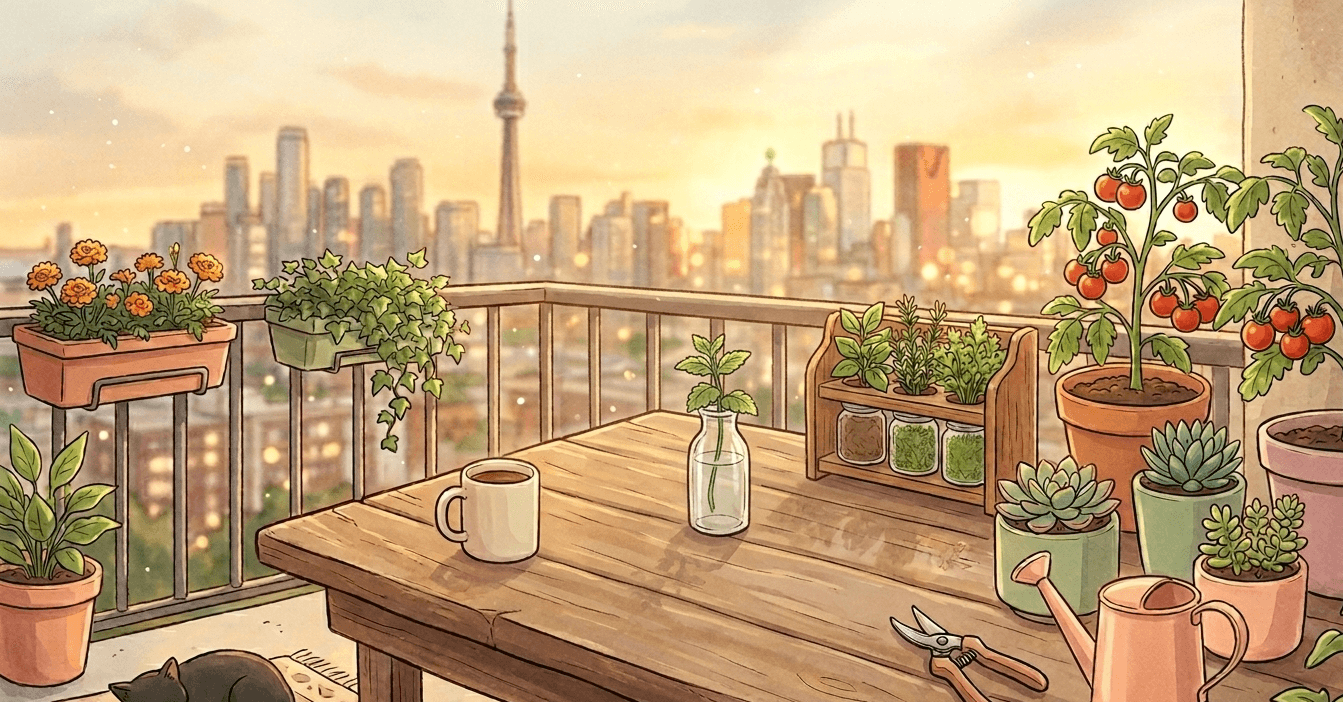
For residents of Toronto, Montreal, or Vancouver, the dream of a lush garden often collides with the reality of concrete and glass. Growing on a Canadian balcony isn't simply about arranging a few pots — it's a practical challenge where restricted space and unpredictable winds dictate the rules.
The urban balcony gardener faces a two-sided problem: the urban heat island effect means sun-exposed concrete surfaces can reach 40–50°C in summer, baking roots from below. Meanwhile, wind speeds that can stress or topple unprotected plants increase with every floor. Turning these elevated platforms into productive growing spaces takes planning, but it's entirely achievable.
This guide covers five actionable strategies that work whether you're on the 5th floor of a Montreal walk-up or the 30th floor of a Toronto tower. Every recommendation is adapted for the realities of Canadian urban growing — short seasons, strong winds, and tight spaces.
Mapping Your Balcony's Sun
Before choosing plants, figure out how much direct sunlight your balcony actually receives. Most fruiting vegetables — tomatoes, peppers, cucumbers — need 6–8 hours of direct sun per day. Leafy greens and herbs can manage with 3–4 hours.
Track sunlight over a full day by checking your balcony every 2 hours and noting which areas are in direct sun, partial shade, or full shade. Alternatively, a cheap light meter or a free phone app (like Sun Seeker or Lumos) can map your sun pattern in minutes.
South & West-Facing
Best for fruiting crops (tomatoes, peppers, cucumbers). Expect 6+ hours of sun in summer. Watch for afternoon overheating — container surfaces can get very hot.
North & East-Facing
Better suited for leafy greens, herbs, and shade-tolerant varieties. You may get 2–4 hours of direct sun. Skip heat-loving crops like tomatoes unless you have reflected light from adjacent buildings.
The Altitude Paradox: When Height Redefines Your Hardiness Zone
One of the most common mistakes is assuming the climate at ground level is identical to that on the 27th floor. In practice, experienced balcony gardeners treat higher floors as roughly half a zone to one full zone colder for every 10–15 storeys — primarily due to increased wind exposure and reduced shelter, not pure altitude effects. This is a practical estimate, not a published formula; conditions vary by building orientation and surrounding structures.
A balcony in Toronto geographically located in Zone 6B may behave like Zone 5B — or even 5A on an exposed corner unit. This effective cooling, compounded by persistent wind, means you should delay planting by 10 to 14 days compared to ground-level gardens to avoid late frosts. Corner units are particularly vulnerable, experiencing the strongest wind acceleration.
The Venturi Effect on High-Rise Balconies
Wind channelled between buildings can accelerate significantly — a phenomenon loosely analogous to the Venturi effect. This drives rapid moisture loss from leaves faster than roots can replace it, causing plants to wilt and dry out within hours on exposed balconies. Corner units and upper floors experience the worst of this effect.
Balcony Zone Shift Calculator
Ground-Level Zone
6B
Your Balcony Zone
6A
Planting Delay
+0 days
At ground level, your balcony matches the city’s base hardiness zone. Standard planting dates apply.
Zone shift is a rough estimate (~½ to 1 zone per 10–15 floors), not an exact formula. Wind exposure adjusts for channelling effects between buildings. Always verify conditions with a min-max thermometer or your local garden centre.
Approximate Last Frost Dates for Major Canadian Cities
Add your planting delay (from the calculator above) to these dates for your balcony planting window.
The Container Duel: Why Fabric Grow Bags Outperform Plastic
Your choice of container has a direct impact on root health. While plastic pots are ubiquitous, dark-coloured ones function as thermal traps — surface temperatures can reach 49°C or higher under direct summer sun, a threshold where root damage begins for many species.
Fabric grow bags made from BPA-free polypropylene offer scientifically superior advantages for balcony growing:
Air Pruning
In a rigid pot, roots circle until they suffocate. Porous fabric allows root tips to contact air, which naturally "burns" the tip and stimulates the plant to produce a dense, fibrous root mass — dramatically improving nutrient absorption.
Thermal Regulation
The breathability of fabric allows heat to escape through evaporative cooling. Research shows fabric containers average about 6°C cooler than black plastic, with differences reaching 10–15°C under peak summer radiation.
The hidden cost of fabric bags
Fabric containers sacrifice usable volume. The outer 1–2 inches of substrate dries quickly, creating a zone that roots can't effectively use. A 5-gallon fabric bag typically provides only 3 to 4 gallons of usable root zone — roughly a 20–40% reduction. Always size up: use a 7-gallon bag where you'd normally use a 5-gallon rigid pot.
Container Comparison
Sort by column · Filter by type · Tap to expand on mobile
We may earn a commission from qualifying purchases. Prices change often—confirm at checkout.
| Container | Type | Air Pruning | Best For | |||
|---|---|---|---|---|---|---|
fabric | Yes | Check price ~33°C | $12–$18 CAD | 3–5 seasons | Peppers, cucumbers, larger root systems | |
fabric | Yes | Check price ~35°C | $8–$12 CAD (5-pack) | 2–3 seasons | Tomatoes, herbs, lightweight setups | |
Terracotta Pot 12" | ceramic | No | ~38°C | $15–$30 CAD | 10+ seasons (freeze-thaw risk) | Herbs, Mediterranean plants, aesthetics |
plastic | No | Check price ~45°C | $30–$80 CAD | 5–10 seasons | Busy schedules, consistent moisture needs | |
Standard Nursery Pot 5-Gal (Plastic) | plastic | No | ~49°C | $3–$6 CAD | 5–10 seasons (UV dependent) | Budget setups, shaded balconies |
Top Picks: Balcony Garden Essentials
Affiliate links — we may earn a commission at no extra cost to you.
The Genetic Revolution: Micro-Dwarf & Determinate Varieties
On exposed balconies, tall indeterminate varieties (those with continuous growth) act as sails, catching wind and increasing the risk of toppled pots or snapped stems. The solution: determinate or micro-dwarf varieties that stay compact and low, naturally shrugging off gusts.
Cultivars like the Tiny Tim tomato, which tops out at 10–12 inches in containers, deliver a generous harvest in about 45–55 days. Their low centre of gravity keeps your balcony garden intact through summer storms.
| Vegetable | Variety | Pot Size | Height | Days to Harvest | Wind Resistance |
|---|---|---|---|---|---|
| Tomato | Tiny Tim (Micro-Dwarf) | 1 gallon | 10–12" | 45–55 | Excellent |
| Bean | Mascotte (Bush) | 2–3 gallons | 16–18" | 50–60 | Good |
| Cucumber | Patio Snacker (Compact) | 5 gallons | 24–30" | 55–65 | Moderate |
| Pepper | Lunchbox (Snack Pepper) | 3 gallons | 18–24" | 60–75 | Good |
| Lettuce | Tom Thumb (Butterhead) | 1 gallon | 6–8" | 30–45 | Excellent |
Tomato
Wind: ExcellentTiny Tim (Micro-Dwarf)
Bean
Wind: GoodMascotte (Bush)
Cucumber
Wind: ModeratePatio Snacker (Compact)
Pepper
Wind: GoodLunchbox (Snack Pepper)
Lettuce
Wind: ExcellentTom Thumb (Butterhead)
Succession planting for continuous harvests
With quick-maturing dwarf varieties, you can stagger plantings every 2–3 weeks for a continuous supply. A Tiny Tim tomato planted in early June will be harvesting by mid-July — start a second batch as the first begins fruiting to extend your season through September.
Taming the Wind: Stabilization Physics at Height
A pot that topples is a major safety hazard in high-density environments. Stabilization relies on managing the centre of gravity and the aerodynamic profile of your container arrangement.
Internal Ballast
Place 2–3" of washed gravel or broken bricks at the bottom of containers before adding substrate. Lowers the centre of gravity without permanent fixtures that violate lease agreements.
Strategic Clustering
Group pots together — heaviest containers on the windward perimeter, lighter pots sheltered in the centre. The cluster acts as a collective windbreak, reducing drag on individual plants.
Mechanical Stabilizers
Systems like the TopHat basket use a wide-base metal ring to lock pots in place. The weight transfers to a stable circular structure that resists lateral wind forces without drilling into railings.
Renter-friendly — no drilling required
All three stabilization methods work without permanent modifications to your balcony. Internal ballast, clustering, and basket stabilizers are fully portable and comply with standard Canadian lease agreements that prohibit structural alterations.
Check your condo's bylaws first
Many Canadian condo corporations have bylaws restricting what can be placed on balconies — including weight limits, fire-code clearances, and drainage requirements to prevent water damage to units below. Check with your property manager before setting up containers, and always use saucers or trays to catch runoff.
Substrate Architecture: Never Call It "Dirt" Again
Traditional garden soil is the enemy of the balcony: it compacts, suffocates roots, and drains poorly. A high-performance substrate must be engineered from peat moss, coir (coconut fibre), and perlite for maximum porosity.
In Canada, mixes like Pro-Mix integrate Mycoactive technology — the addition of mycorrhizal fungi that form a symbiosis with roots, artificially extending their reach to draw water and minerals from a larger volume of substrate. In these ultra-draining mixes where wind-accelerated evaporation is constant, pairing with a drip irrigation system (like the Blumat Classic) becomes essential for maintaining consistent hydration without waste.
| Layer | Material | Depth | Purpose |
|---|---|---|---|
| Bottom (drainage) | Washed gravel or perlite | 1–2" | Ballast + prevents waterlogging |
| Core (growing) | Pro-Mix with Mycoactive | Fills container | Peat + coir + perlite + mycorrhizae |
| Top (mulch) | Straw or shredded bark | 1–2" | Reduces surface evaporation significantly |
Protect your mycorrhizae
Synthetic fertilizers (especially high-phosphorus formulas) can suppress mycorrhizal colonization. Use organic fertilizers or slow-release granules to maintain the fungal symbiosis throughout the growing season. Most Canadian garden centres carry Pro-Mix and comparable mycorhizae-enriched blends.
Watering Your Balcony Garden: Frequency, Signs, and Systems
Fabric grow bags and wind exposure mean balcony containers dry out far faster than ground-level gardens. During hot summer weeks, you may need to water once or even twice a day. Consistent moisture is the single biggest factor in container productivity.
The simplest check: lift the pot. A well-watered 5-gallon fabric bag feels noticeably heavy. If it feels light, water until you see runoff from the bottom. You can also push a finger 1–2 inches into the substrate — if it feels dry, it's time to water.
Manual Watering
Water in the morning before 10 AM to reduce evaporation. Evening watering is a backup, but wet foliage overnight can encourage fungal disease.
Self-Watering Inserts
Reservoir-based planters (like the Lechuza Balconera) reduce watering to every 3–5 days. Good for frequent travellers, but check the reservoir weekly to prevent mosquito breeding.
Drip Systems
The Blumat Classic uses ceramic cones that release water as the substrate dries — no electricity, no timer. Ideal for balconies with 5+ containers.
The Boreal Living Verdict
Balcony gardening takes more planning than ground-level growing, but the payoff is real: fresh herbs and vegetables steps from your kitchen, even on the 20th floor. By understanding your microclimate, choosing the right containers and varieties, and engineering your substrate, you can grow a productive garden in surprisingly little space.
For most Canadian condo dwellers, start with Vivosun fabric grow bags ($17 for a 5-pack), a bag of Pro-Mix Organic ($15), and a packet of Tiny Tim seeds (~$8). Total investment under $45 — and your first harvest in about 55 days.